
Treadwell Case Study: TLDR
Treadwell is Discount Tire’s personalized tire recommendation tool, designed to help customers find the right tires based on their vehicle, driving location, and habits. While the tool itself was powerful, research revealed that customers didn't fully understand or trust how recommendations were generated, creating friction at the introduction stage.
I partnered across research and design to identify these trust and comprehension gaps through a multi-variant study, then redesigned the Pre-Step experience and validated the winning approach through A/B testing.
Team: Stephanie McNicol (Principal UX Designer, design & research), Carolina Lagarda (Senior UX Designer, design refinement in A/B testing)

Key Challenges
Comprehension
Customers often didn't understand how Treadwell generated recommendations. Many were unclear about what information the tool used or where its data came from, making the experience feel opaque.
Brand Confusion
Users frequently mistook Treadwell for a tire brand or retailer rather than a recommendation tool, creating trust barriers before they even engaged with the experience.
Trust & Confidence
Even when customers understood the concept, they weren't always confident in the recommendations. The existing introduction failed to clearly connect customer inputs with the personalized results they would receive, leading many users to bypass the tool and browse tires on their own.
Research Approach
To better understand the drivers behind Treadwell’s trust and comprehension gaps, I designed a blind, between-subjects survey study using mobile prototypes that reflected how most customers encounter the experience.
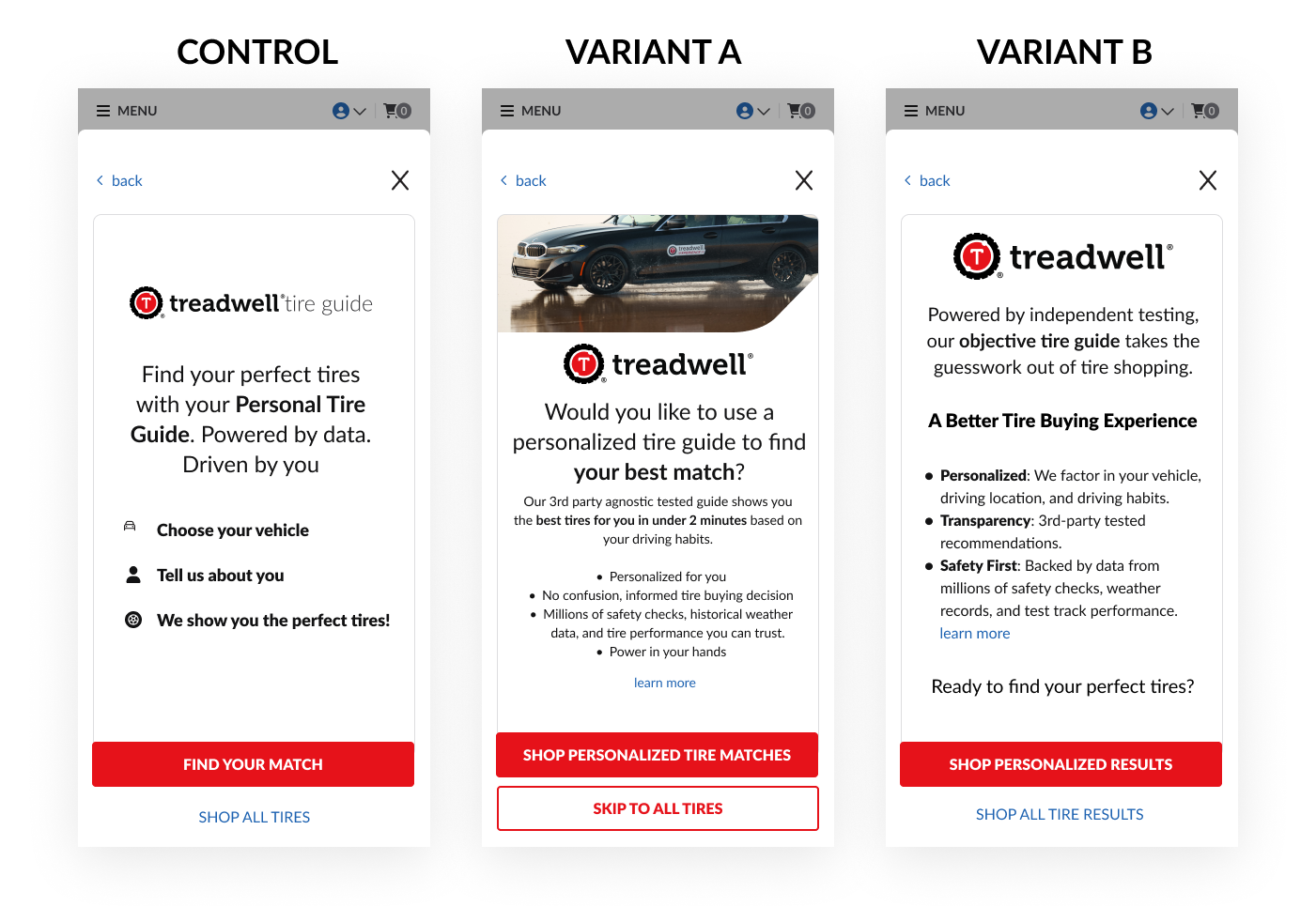
The study evaluated three versions of the Treadwell Pre-Step screen: the existing experience, a variant highlighting third-party testing and recommendation inputs, and a variant with a simplified layout and clearer value proposition. 90 participants were evenly distributed across the three concepts and assessed on comprehension, trust, recall, confidence, and ease of use.
Key Findings
The Pre-Step Drives Success
The guided Treadwell Pre-Step proved critical to the experience. Task success reached 90% with the introduction in place, compared to just 47% without it.
More Transparency Builds Trust
Variants A & B that clearly explained Treadwell's inputs, data sources, and value proposition outperformed the control experience across comprehension, confidence, and trust. The strongest-performing concept used direct messaging rather than aspirational language.
Clear Language Matters
Customers responded best to straightforward descriptions like "personalized tire recommendations" and "third-party tested recommendations." Ambiguous terms and vague prompts created confusion and, in some cases, unnecessary concern about sharing personal information.
Brand Confusion Remained
Despite improved messaging, many participants still mistook Treadwell for a tire brand rather than a recommendation tool, highlighting the need for stronger alignment between the Treadwell and Discount Tire brands.
Customers Wanted More Information
Participants expected an easy-to-find "Learn More" option within the experience, making its placement a key design recommendation.
Design Iterations
Research findings directly informed a redesigned Pre-Step and a set of A/B test concepts.
Improved Clarity
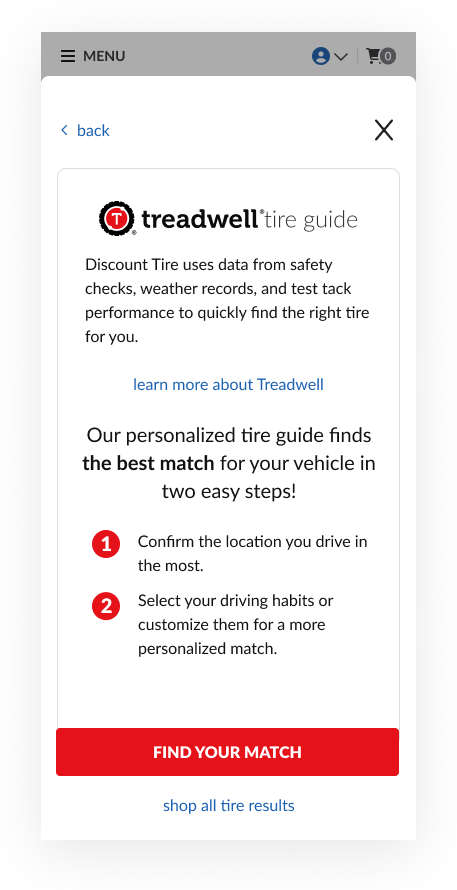
The redesign focused on readability and transparency through left-aligned text, active voice, and explicit explanations of the inputs used to generate recommendations. Vague prompts like "Tell us about you" were replaced with language that clearly set expectations for the experience.
Personalized Entry Points
For signed-in customers, the experience leveraged known vehicle information to create a more relevant and personalized introduction. Signed-out users received the same clear structure and messaging, without the personalized context.
A/B Test Validation
The test concepts incorporated the core improvements, including clearer messaging, Treadwell Tire Guide branding, explicit input explanations, and a "Learn More" link. Variations focused on headline framing and the prominence of third-party testing claims, with testing running through statistical significance.
Outcome
The winning variant was projected to drive $24M in annualized incremental revenue, based on increased completion of the Treadwell flow and resulting tire purchases.
Beyond revenue impact, the study produced a clear, evidence-backed set of guidelines for how to position and communicate Treadwell, including how to frame its value, surface inputs, and connect it to Discount Tire.
From study design through final recommendations, the entire effort was completed in four weeks.